
Provable Fairness
for Every Outcome That Matters
Whenever an outcome carries real value — a game result, a lottery draw, an NFT mint, or any fair allocation — trust begins when that outcome can be confirmed rather than assumed. This framework makes every result emerge from a transparent process that no party can influence and anyone can examine after the fact.
After Every Session, the Proof Becomes Public
Complete Transparency for Every Participant
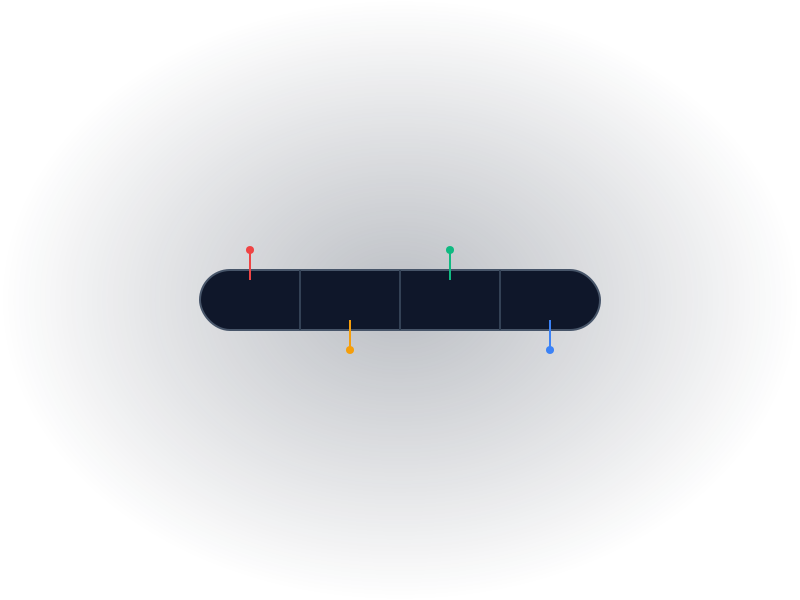
- ✓Seed Generated
- ✓Session Played
- 3Secret Published
- 4Outcomes Verified
How Verifiable Randomness Operates
Four foundational capabilities that establish a trust architecture for game outcomes
Oracle-Generated Entropy
Game outcomes originate from a randomness source that operates independently of the game environment. The oracle service produces entropy that no game participant or operator can anticipate or influence.
Privacy-Preserving Computation
During active play, all outcome-relevant data remains concealed through privacy-preserving methods. Players and observers cannot access pending results, preserving strategic uncertainty until the appropriate moment.
Operational Role Separation
The architecture distributes responsibilities across distinct components. No single service possesses both the generation authority and the consumption rights for randomness data.
Retrospective Auditability
Following each session, the parameters governing all outcomes become publicly accessible. Participants may reconstruct the full sequence of events and confirm that rules operated as designed.
Verification Integrity Across the Architecture
Game outcomes follow a structured path from generation through delivery, where each transition is observable and confirmable.
  _____ ____  _   _ _____    ____  _  _  _ _   _ _____ ____  ____  _   _ ___ ____
 |_   _|  _ \| | | | ____|  / __ \| |/ | | | \ | | ____|  _ \/ ___|| | | |_ _|  _ \
   | | | |_) | | | |  _|   | |  | | |/| | |  \| |  _| | |_) \___ \| |_| || || |_) |
   | | |  _ <| |_| | |___  | |__| | / | / | |\  | |___|  _ < ___) |  _  || ||  __/
   |_| |_| \_\\___/|_____|  \____/|_/  |_/|_| \_|_____|_| \_\____/|_| |_|___|_|
Where Verifiable Randomness Applies
The randomness infrastructure governs outcome generation across distinct game mechanics

Treasure Placement
The location of hidden rewards within each session is governed by the randomness framework. The oracle combines session-specific inputs to produce placements that remain concealed until discovery occurs.

Reward Classification
When a player earns a reward, its classification follows a probability-governed framework defined at the protocol level. Each tier carries a prescribed likelihood derived from the session parameters.

Session Lifecycle Integrity
From creation through conclusion, each game session operates under a consistent set of randomness parameters established at the outset. The lifecycle ensures that conditions remain stable and tamper-resistant throughout play.
Strategic Element Allocation
The distribution of game elements at session start follows an entropy-based process. Initial conditions are shaped by the randomness foundation, providing each participant with a fair starting position.
Why Players Can Trust Every Outcome
structural guarantees that place fairness beyond organizational control
The trust model is built on the principle that fairness should be a property of the system itself, not a promise from its operators. Every design decision serves this objective.
The system operates beyond the reach of any internal party. Operators, developers, and infrastructure providers cannot preview or alter outcomes, so everyone takes part on equal terms.
Fairness here does not depend on trusting an organization. Outcomes are governed by open math that anyone can check — not by the reputation of whoever operates the service.
Each session records its key parameters on-chain, creating a permanent, tamper-proof trail. Anyone can revisit this record at any time to review the conditions past sessions ran under.
The platform has layered safeguards that can respond to problems at different levels. A targeted fix can address one specific issue without disrupting unrelated active sessions.
Design Philosophy Behind the Fairness Architecture
principles that govern how the system earns and maintains trust
Separation of Knowledge
- •The randomness system distributes sensitive information across isolated components, ensuring no single service holds the complete picture
- •The oracle that generates the initial entropy does not control how outcomes are derived, and the service that derives outcomes cannot influence the initial entropy
- •Players benefit from a design where structural independence, rather than policy or oversight, enforces the integrity of every result
Consistency Through Protocol-Level Governance
- •Distribution parameters are established at the protocol level and remain fixed across all sessions
- •Reward classification, allocation weights, and outcome rules operate under consistent conditions that are not subject to session-specific adjustment
- •This protocol-level consistency ensures that every player's experience adheres to the same foundational rules

Disclosure as an Accountability Mechanism
- •When a session concludes, the platform publishes the parameters that governed all outcomes during that session
- •This disclosure transforms fairness from a claim into a confirmable fact — any participant can trace the logical path from initial conditions to final outcomes
- •Accountability is embedded in the system's design rather than delegated to external auditors or trust-based reports
Why Conventional Randomness Falls Short
common approaches leave gaps that let outcomes be manipulated
Operator-Controlled Outcomes
When a single company generates the results, it holds full authority over outcomes — and can influence them without anyone outside noticing.
Unverifiable Claims
Participants receive outcomes with no proof attached. Claims of fairness cannot be checked, because there is no independent way to confirm them.
Closed Distribution Logic
The rules that decide who gets what run behind closed doors, so no one can confirm whether the stated odds are actually applied.
How Randomness Risks Are Addressed
through layered verification at every stage of the process
Authenticated at Creation
Each generated outcome carries a proof of its origin and integrity from the moment it is produced. This authentication occurs before the result enters the game environment, ensuring that only verified data influences game state.
Validated Before Consumption
Smart contracts enforce a mandatory confirmation step before using any randomness-derived result. This on-chain checkpoint prevents unverified or tampered data from reaching game logic.
Infrastructure Isolation
The generation, derivation, and delivery of randomness data occur across independent infrastructure layers. Each layer operates with limited visibility into the others, preventing any single point of compromise from affecting the full process.
Randomness Verification Applied
LUDOPOLY
Verifiable Randomness in Practice
Randomness Framework in Production
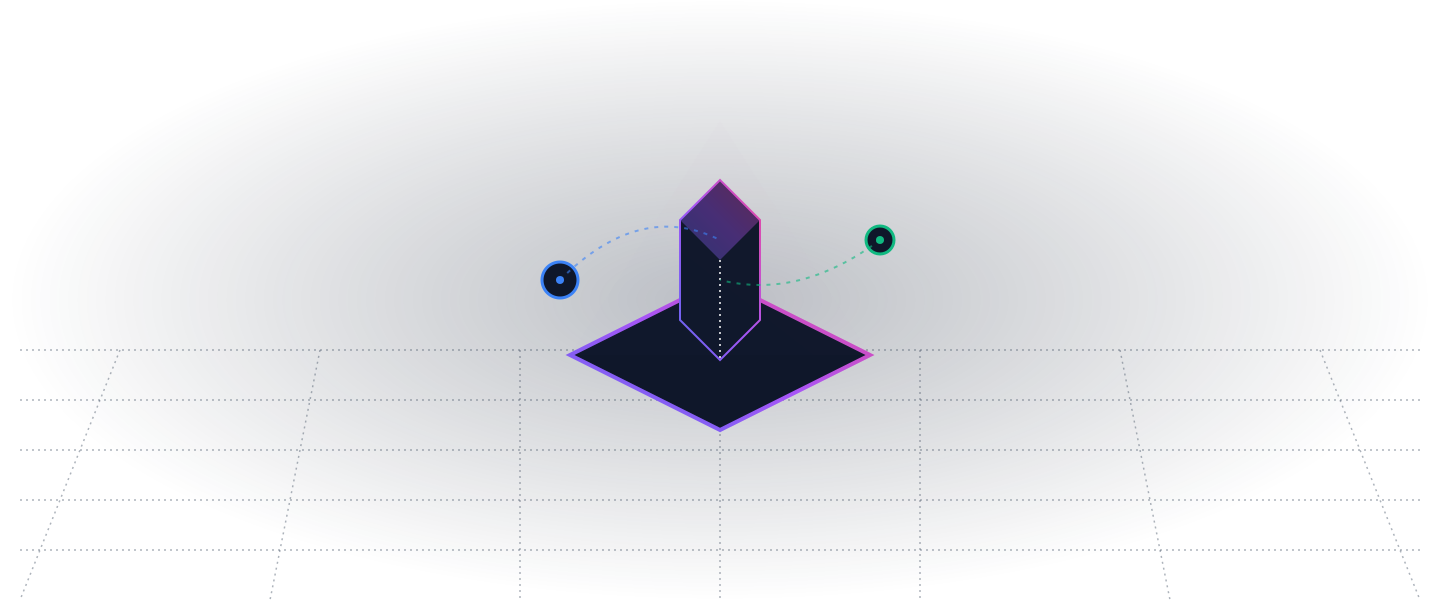
The Ludopoly game serves as the primary environment where the verifiable randomness framework operates under real conditions. Treasure placement, reward classification, and session management all run through the same fairness infrastructure available to every studio on the platform.
Explore Verification Framework→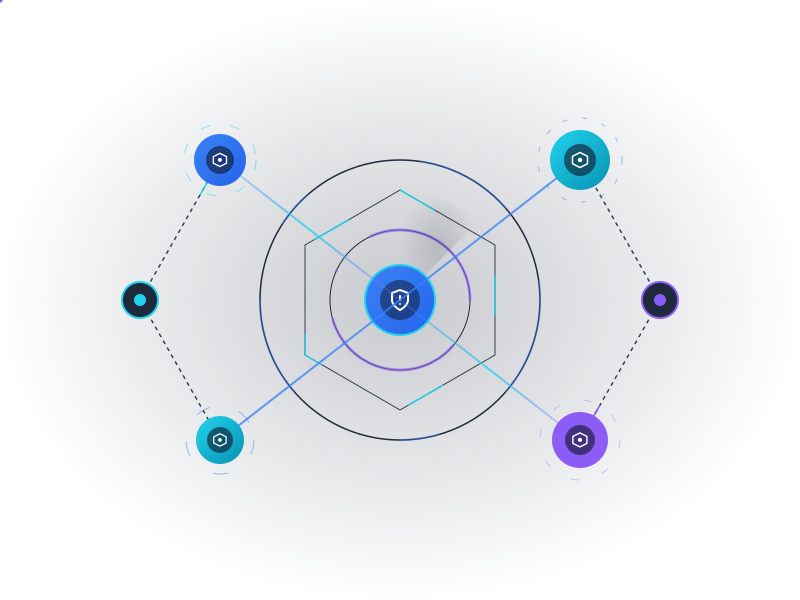
The oracle infrastructure manages proof verification, outcome validation, and session-end disclosure through a resilient architecture with built-in redundancy.
Review Oracle Architecture→PROVABLE FAIRNESS
Explore the Verifiable Randomness Framework
Every generated outcome carries confirmable proof. Players and studios can examine the fairness of any session through an open, structured verification process.